
Stop Chasing Hype

Paul Jackson’s Market Outlook for the Second Half of 2026
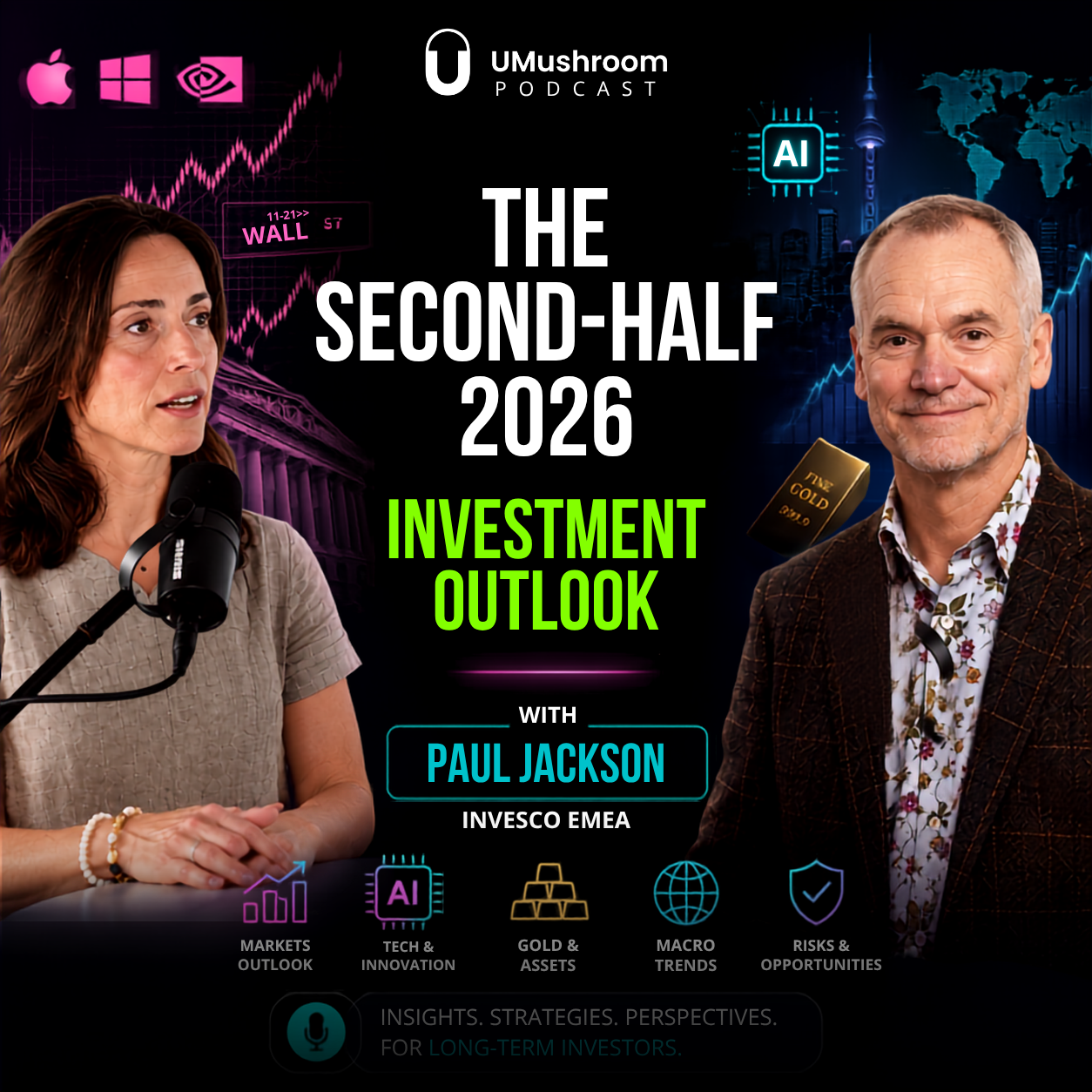
Paul Jackson of Invesco on AI, interest rates, gold and the opportunities investors may be overlooking
Markets entered 2026 in an optimistic mood—and quickly became harder to read. Technology shares continued climbing, energy prices reacted to geopolitical tensions, and dramatic reversals in gold and cryptocurrencies reminded investors how quickly popular trades can change direction.
In the latest UMushroom podcast episode, Luba Schoenig welcomes back Paul Jackson of Invesco to explore what could shape markets during the second half of the year.
The central question: are the assets receiving the most attention still where the best opportunities lie?
Is the AI Trade Already Changing?
Artificial intelligence remains a powerful investment theme, but the companies attracting the biggest headlines are not necessarily delivering the strongest returns.
Paul explains that markets are beginning to question how quickly major technology companies can monetise their enormous investments in AI infrastructure. Meanwhile, many of the businesses supplying the equipment—from semiconductor producers to computer manufacturers—have performed strongly.
As economic conditions improve, market leadership could broaden further towards small and mid-sized companies, value stocks, industrials, financials, metals and mining.
The next opportunity may not be the headline stock everyone is already watching.
The Fed May Do Less Than Investors Expect
Will the US Federal Reserve raise interest rates—or begin cutting them?
Paul expects neither.
Lower energy prices could bring headline inflation down, but persistent core inflation may prevent the Fed from cutting rates. His base case is that US interest rates remain unchanged through the rest of 2026 and into the first half of the following year.
That stability could keep short-duration, defensive investments attractive. Longer-term bond yields, however, may still rise if the Federal Reserve reduces its balance sheet and places additional US Treasuries back into the market.
For investors, an unchanged policy rate does not necessarily mean an unchanged bond market.
Why Did Gold Fall During a Crisis?
Gold is traditionally viewed as protection against geopolitical uncertainty. Yet when conflict intensified, its price fell rather than rising.
Paul believes gold had simply become too expensive.
Investment demand had surged as rising prices encouraged more investors to join the trend. At the same time, demand from central banks and jewellery buyers had weakened. In other words, fear of missing out may have become a stronger driver than the fundamentals.
Gold can still play an important diversifying role over the long term. But even a traditional safe haven can disappoint when too much optimism—or too much bad news—is already reflected in its price.
Silver faces a similar challenge. Its smaller and less liquid market can produce even sharper movements in both directions.
Could the Better Value Be Outside the US?
Paul sees greater relative value in Europe and emerging markets, where valuations are generally less demanding than in the US.
China remains inexpensive despite its progress in areas such as technology and robotics. Taiwan and South Korea have benefited strongly from the AI investment cycle, although Paul cautions against assuming that their exceptional recent performance can continue indefinitely.
A gradually weaker US dollar could also support emerging-market assets and commodities.
The message is not to abandon the US. It is to remember that market leadership rarely remains concentrated in one country, sector or investment theme forever.
The Advice That Matters Beyond 2026
Forecasts change. Market leaders change. Investor behaviour often does not.
Paul’s closing advice is straightforward: avoid unnecessary trading, invest gradually and remain committed to a well-diversified long-term strategy.
Trying to predict every market turn can lead to more costs, more mistakes and emotional decisions. Allowing long-term returns to compound may be less exciting—but often more effective.
As Paul puts it:
“Don’t get too clever.”
Key Takeaways
-
Market leadership could broaden beyond the largest AI and technology companies.
-
Paul expects the Federal Reserve to keep interest rates unchanged.
-
Gold remains a potential diversifier, but valuation and investor behaviour still matter.
-
Europe, China and emerging markets may offer opportunities beyond crowded US trades.
-
Discipline and diversification are more reliable than chasing recent winners.
Watch the Full Conversation
Which markets could benefit from stronger economic growth? Can AI spending generate sufficient returns? And what should investors consider before buying gold, silver or rare-earth metals?
Watch the complete conversation with Paul Jackson on YouTube.
Hear it on your favourite music platform:
Spotify
Apple Podcast
For anyone reviewing their portfolio for the second half of 2026, this episode offers a timely reminder: Follow the fundamentals, stay diversified and resist the temptation to chase the hype.

