
The Power of UMushroom Filters!

A Beginners Guide to UMushroom Filters - How they work and how to use them
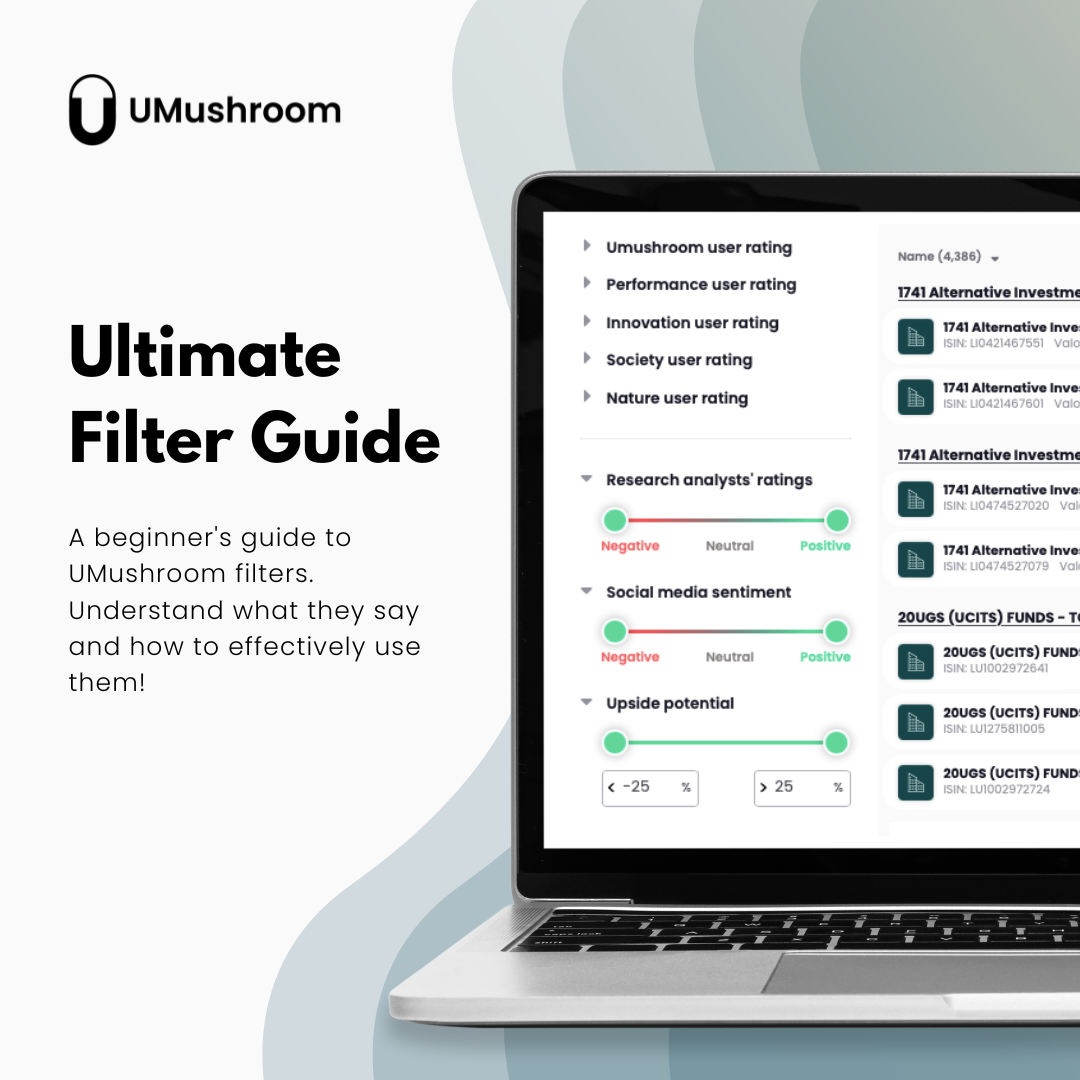
UMushroom Filters
We at UMushroom have created this guide to help you find the perfect investments for you. We will walk you through all of the filters available on UMushroom for every type of investment. We will explain how they can help you sift through the jungle of financial information. And we will provide examples as to why they are important!
This is a great step in your investment journey and will help you work out where to start!
Get reading!
Let's start off with general filters!
The UMushroom user rating.
The UMushroom user rating is the overall score UMushroom users give to a security. It enables you to see what fellow investors think of said security, which can be used in finding stocks with good public backing.
Performance user rating.
This metric shows how other UMushroom users perceive a securities price performance, past and future. You can see whether other users believe it has been and will be a good or bad stock to hold, giving a powerful insight into the hive mind.
Innovation user rating
As it says in the title, this displays how innovative other UMushroom users think the company is. Remember that innovation is pivotal to climbing and staying at the top of a sector, so this is one to watch out for.
Society and Nature user rating.
How friendly do UMushroom users believe the company/ fund is to society? And how eco-friendly do UMushroom users believe the company/ fund is? If ESG values are something you consider, use this filter; set it to 4 or 5 stars. Ensure that you are investing only in the friendliest of firms!
At UMushroom, we believe that sentiment is pivotal for identifying profitable investments. As the UMushroom community grows, these will become key in identifying investment opportunities!
Performance
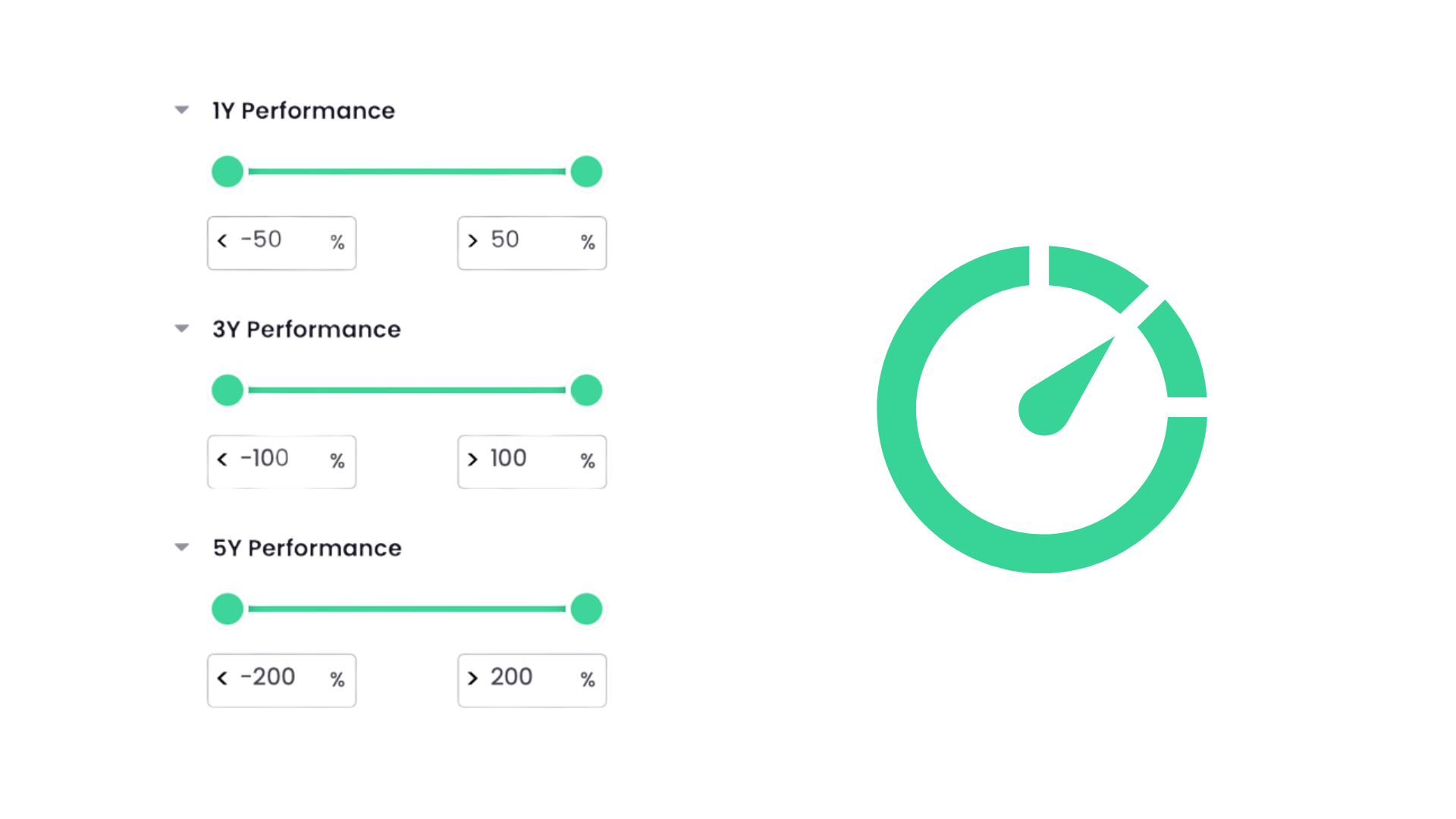
Performance measures how much a stock price or fund NAV (a fund NAV is essentially its share price) has changed over a specified period: its performance. The timeframes we have identified as valuable are:
1Y performance
3Y performance
5Y performance
This is a core filter. It is designed to show how a company has done in the past. A robust historical performance can indicate a well-run company with healthy financials. But remember, past performance is not necessarily an indicator of future success!
Volatility
Volatility measures how much a securities price varies over a specified period. High volatility stocks move up and down a lot. Low volatility stocks stay close to the average price and do not vary much. Our chosen timeframes for volatility are:
1Y
3Y
and 5Y.
These timeframes show how volatile a security's price has been both recently and over the long run.
Volatility is, in essence, how risky investment into this stock was in the past. If you want to be safe, you want the price of your investment to be stable, not drastically swinging up and down. So, picking low-volatility stocks would be key! On the other hand, high volatility could be a good thing; lots of price movement could mean lots of return.
We consider low volatility stocks to have below 20% variance (up and downiness) from the mean. There will be another post to explain more about this later!
Equity Specific Filters
Research analysts' ratings
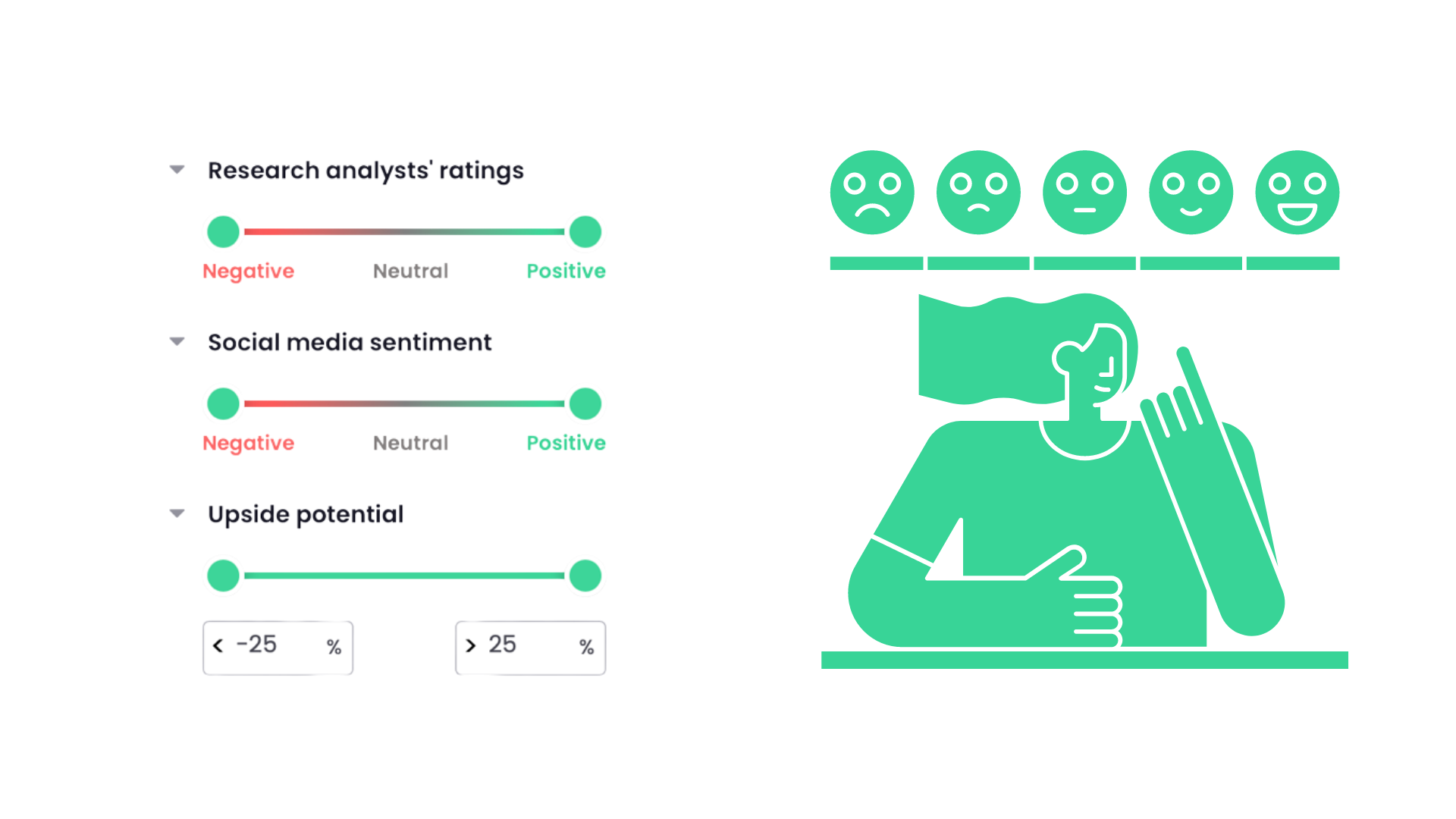
This is just a measurement of what analysts at banks think of a stock. They evaluate whether it is underpriced, overpriced or at fair value. Whether it has space to grow or it is in a contracting market. Whether there is faith in the management and staff. And many more metrics. All these thoughts are then aggregated into three main groups: Buy, Sell, and Hold. If most analysts think a stock will do well in the future, then the average rating will be a buy.
UMushroom presents this information as a scale, showing the analyst consensus. If you trust the analysts, this is a key metric to investigate!
Professional media sentiment
What are professionals on social media saying about a stock? We collect information from Sentify, who use machine and artificial learning tools to decipher what traders, bloggers, journalists and many more think about a company. We present this on a scale from very negative to very positive.
Media sentiment, as ever, is sensitive to huge swings. This is a filter to watch over the long term. Is the positive sentiment a short term swing or a long-term trend indicating fundamental strength? Follow this filter closely!
Upside potential
The upside potential is the median amount by which analysts expect a stock to grow in the next 6-12 months. Searching for stocks that analysts expect to grow substantially is an intuitive place to start an investment journey. Always remember, though: analysts are not always correct!
Upside potential is measured as a percentage. 100% indicates analysts expect the stock price to double in the next 6-12 months, -50% means that analysts expect the stock price to half over the same period.
Currency
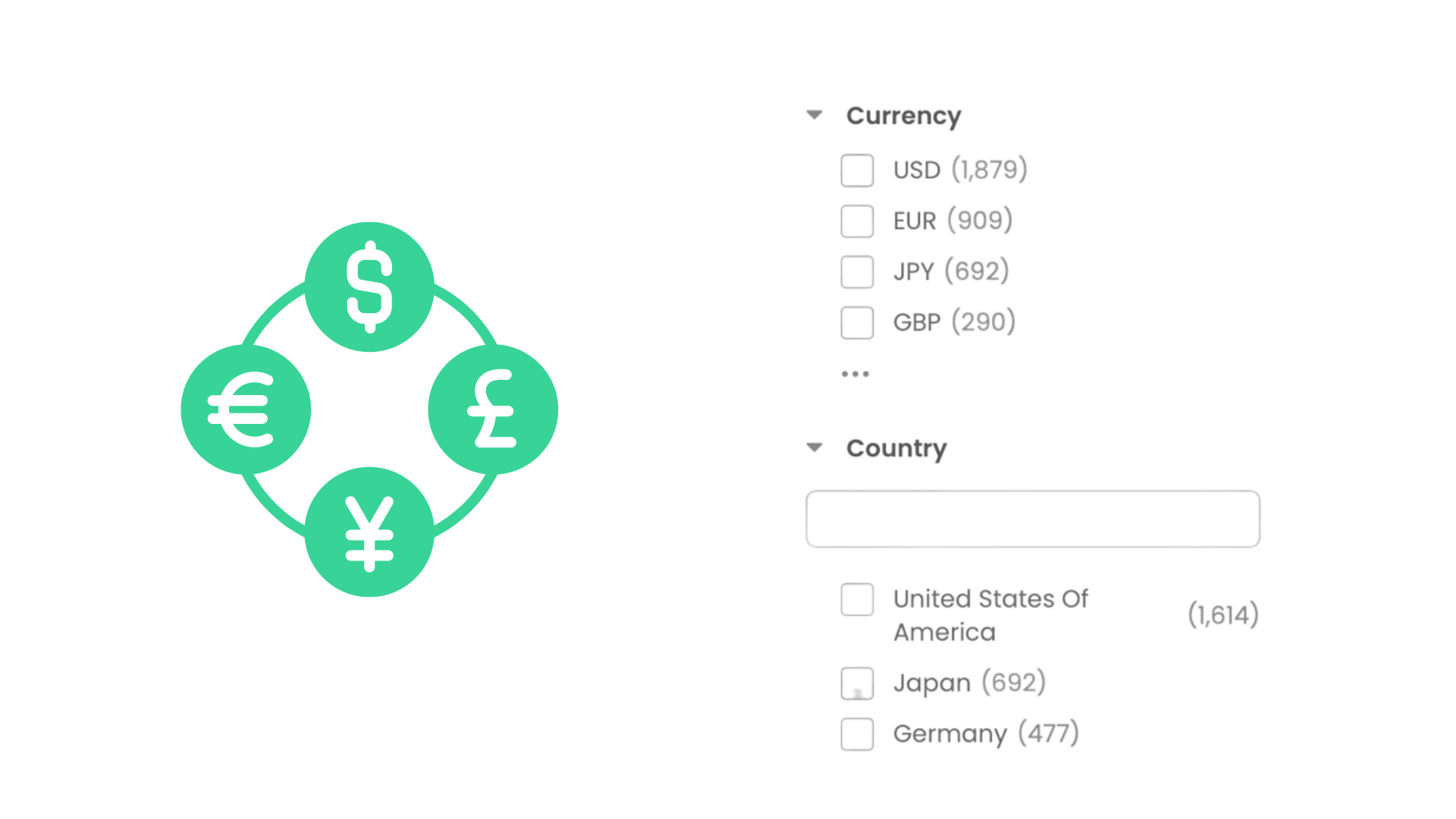
The currency in which the equity is listed.
It will be the local currency of the exchange on which the equity is listed. Unless it is an ADR, in which case, it will be in USD. An ADR (American Depository Receipt) is a certificate sold by the US depository bank representing a specific number of foreign shares. It is used to make oversees stock accessible to US citizens. The same is the case for a GDR across the world in various currencies.
If you are purchasing stock in a currency other than your local one, you risk that said currency will weaken. Therefore, your investment will lose value in your local currency. This is an important thing to watch out for!
Country
The country in which the company's HQ is. This may be a filter to select if you expect a particular country's economy to grow.
Sector
This filter sorts by the primary sector in which companies operate. Examples include but are not limited to Finance, Industrials, Technology, Healthcare etc.
Think about what sectors are growing and what are declining!
Market cap
The Market Cap is the total value of a company's publicly traded common shares. In essence, if somebody were to buy up all available shares (with voting rights), what would they have to pay at current prices?
Large market cap stocks are often less volatile and safer investments than small market cap stocks. Small market cap stocks are often more volatile and riskier investments but offer high potential returns. Play around with this one and see what different cap investments offer!
Dividend yield
The dividend yield is the annual amount received in dividends per share divided by the price of a singular share, yielding a percentage that can be easily compared across the market. If you are searching to buy a stock as a one-off and get that sweet passive income over the coming years, the dividend yield is the filter to go by. Set it high and start that passive income flow!
PE ratio
The P/E ratio is calculated by dividing the share price by earnings per share (net profit generated per share of equity issued) over a designated period. It is what the stock market values $1 of net company earnings at.
If investors are willing to pay way above the sector average per $1 worth of earnings, the stock may be overpriced or a stock expected to grow substantially. If the PE of a stock is very low compared to the sector average, it may be underpriced or a stock that the market expects to decline in value over the coming years. PE on its own does not say a lot but can be meaningful when used with other metrics.
EPS
The earnings per share are simply a company’s net earnings divided by its number of outstanding common stock. This represents how much money the company makes per share issued.
This is a good indication of a company’s profitability. It can therefore be used to forecast future dividend returns or reinvestment.
Funds
Ongoing charges
The ongoing charges are the price a fund charges per annum for managing your money. It is expressed as a percentage of the amount invested and is often between 0 and 5%.
Active investment strategies often cost more than passive investment strategies. This means ETFs are low cost, whereas Hedge Funds charge a lot more. This is important to note, as 5% every year can add up to A LOT and: active-investment performances do not always warrant this.
Sustainability
UMushroom classes sustainability simply and easily. The EU has two sustainability regulations; we give a fund 0, 1 or 2 leaves depending on whether the fund adheres to none, one, or both. This is for those who are environmentally friendly! If you care about our world, tick at least one!
Allowed to buy
Are you allowed to invest in this fund? It is what it says on the tin. This depends on net worth, domicile etc. This is something worthwhile ticking; what is the point of all this research if you can not even invest in the fund?
Investment status
In what phase of the fund’s lifecycle is it in? Is it looking for subscribers to start investing? Is it investing but open to more investment? Is it closed to new investors? The options are:
Hard closed – The fund is not accepting any new investments.
Soft closed – The fund is only accepting investments from people already invested.
Open – Anyone can invest.
And, closed for subscription and redemption – The fund’s current assets are locked under management.
This is another box worth checking; if something is closed, you can not invest in it anyway!
Asset manager
The asset manager is the person making the investment decisions. This is a factor to strongly consider; there is no parity within the Asset Management world. Some boutiques may be specialised in a specific area, whilst some big houses may possess the necessary expertise. Do the research into an asset manager before you pick one of their funds!
Share class currency
Considering the currency follows the same principle as is for equity: under what currency is the fund listed? What currency does it operate in? This is important as currencies gain and lose value. So, which do you want exposure to?
Distribution policy
When dividends and interest are paid out, do you want them reinvested or given to you as passive income? If you opt to receive dividend payments: you will receive a decent passive income. If they are reinvested, your compounded returns will likely end up far higher. You must pick the right one for you!
Distributing => dividends are paid out.
Accumulating => dividends are re-invested.
Classification
This is a slightly closer look at the goals of the fund. Where does it invest? In what country, sector, and style?
For bonds specifically, we include whether the fund invests primarily in:
Corporate, Financial, or Government Bonds.
High Yield (riskier but higher reward) or Investment Grade (safer but lower reward) Bonds.
And for the funds in general, we include:
In which sector the investment strategy focuses on
In which country the investment strategy focuses on
Sometimes the strategy is a blend. Sometimes it focuses specifically on a sector, country and bond type. Sometimes there is no specific strategy, and the idea is simply to make the investor returns!
Benchmark
Does the fund try to maximize risk-adjusted returns, or is its success measured against how an index performs (the S&P 500, DAX etc.)? If it is measured against an index, then this index is known as its benchmark.
Funds with a benchmark often invest in similar securities to those that make up the benchmark itself. It is, therefore, a good investment decision to check the benchmark before purchasing.
Fund size
What is the size of the assets under the management of the fund?
Funds with lots of assets under management may have more liquidity at their exposure and are able to take advantage of lower trading fees. Funds with fewer assets under management may find it easier to keep to their investment strategy. They have less pressure from large sums of money and have a smaller pool of investors.
Launch date
When was the fund launched? When did it start raising funds and investing them?
Older funds have a history of performance. You can see exactly how they have performed in the past under varying investment strategies. Newer funds may have exciting new strategies more adapted to the markets today.
Domicile
Under what legal format is the fund managed? The domicile is where the fund is legally created and managed. Different countries have different regulations that the fund must adhere to. Investigate what laws they follow and then select!
The most common countries that funds are domiciled in are Ireland and Luxemburg.
Replication
If the fund is an ETF, how does it replicate the index it is following?
Physical Replication
This means the ETF tracks the index 1:1; it invests in all components in the same ratios listed.
Physical Sampling
This means the ETF holds a specific selection of securities in the index. The ETF is nonetheless designed to reflect the performance of the underlying index.
Synthetic Replication
The ETF purchases swaps. These swaps are contracts that replicate the profit and loss of the index but mean the fund never owns any of the actual securities.
Work out which one you prefer! All styles should perform similarly to the benchmark. However, a couple of these styles are easier to understand and, as Warren Buffett says, do not invest in things you do not understand!
Interest rate hedge
Does the fund hedge interest rate?
Rising interest rates mean old bonds drop in price; their coupon (interest) payments reflect previous interest rates. So, some bond funds enter into agreements that provide the option to sell their bonds at their original price at a set point in the future (an option agreement). This privilege costs a small sum of money but is imperative if the interest rates are expected to change. During periods of high inflation (like now), interest rate rises are very likely. Making sure you are covered against interest rate rises may be a good move for you!
Currency hedge
A fund hedging a currency will attempt to protect its exposure to the stated currency.
For example, if a fund were to be heavily invested in Canadian bonds but in USD and expects the USD to drop in value. It may not want to sell its bonds to reduce USD exposure, so instead, it may purchase contracts that generate value if the USD drops in value. This will cancel out, or hedge, any currency drops and allow the fund to keep its position. This is important to consider when investing heavily in specific foreign currencies.
Crypto
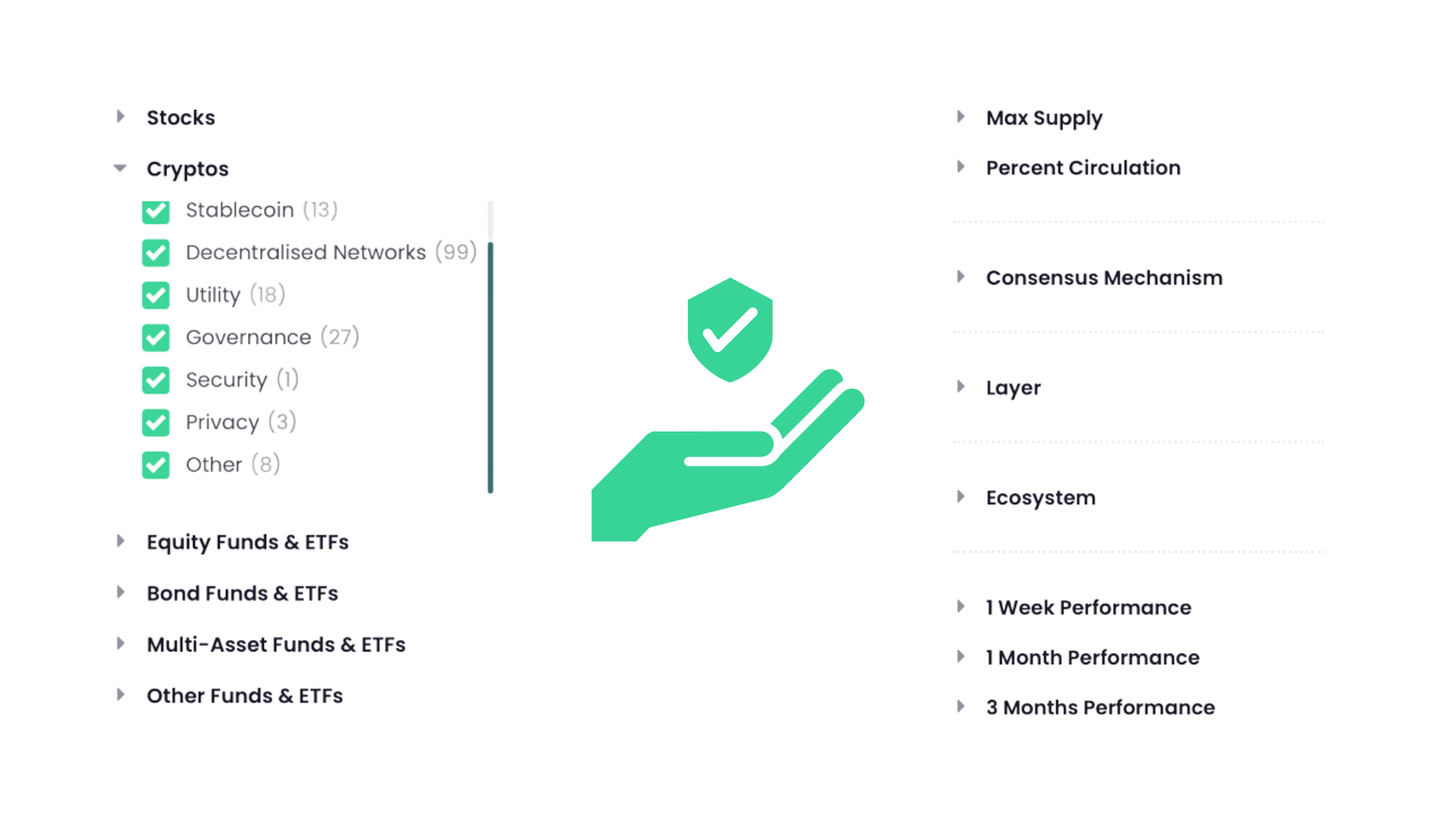
Social media buzz
How buzzing something is on social media.
Has a cryptocurrency suddenly had a lot more attention than usual? If so, it will have a high or extreme social media buzz!
This is important for following the news and seeing which crypto might become volatile in the near future!
Market cap
This is the same as with a stock. It is simply the number of tokens in circulation multiplied by the current market price per token.
Often, as is with stocks, the higher the market cap, the less volatile (risky) the investment. Currencies ranked #1-20 are considered safe compared to other crypto assets. If you are looking for a safer option, go high market cap. If you are looking for a riskier investment with higher potential returns, go low!
Max supply
Often, cryptocurrencies' supplies are capped to make them anti-inflationary. There are two types of caps. Hard and soft. If the cap is defined as a certain number of coins that are ever allowed to circulate, it is a hard cap. Or a maximum supply. Tokens with a maximum supply are supposed to hold their value well, meaning they may be a better long-term investment. They are often spoken about as a way to hedge fiat currency inflation.
Percent in circulation
Percent in circulation is the current circulating supply divided by the maximum supply. In other words, how much of the maximum supply is currently circulating as a percentage?
This is important to check as if it is 1%, the current supply will be diluted 100x over. If it is 99%, the current supply will only be diluted 1.01x over.
Consensus mechanism
A consensus mechanism is simply how a blockchain agrees on what information is correct. This information is then put into blocks and added to the chain. Some mechanisms are more secure than others, some are faster, and some are more environmentally friendly. Here are two common examples:
Proof of Stake (PoS):
Users of a blockchain can stake their coins if they wish to. They stash them away in the network to earn interest. Rewarded by further interest payments, these 'stakers' can opt into confirming transactions running through the chain. These people are called validators.
Proof of Work (PoW):
This pits users of the blockchain against each other. The 'miners’ are people who build the blockchain. They compete to solve puzzles to mine (create) a block. Thousands of computers perform millions of calculations to solve the puzzle. Miners must be truthful about the information in their block, as everyone has a copy of all the information. A big reward is given to the person who solves this puzzle first.
Layer
The crypto space can be broken down into two layers. The layer of a currency is defined by whether it belongs to an L1 or L2 project. L1 projects create an ecosystem, like an app store for other projects. L2 projects are the apps within these stores (see our crypto definitions for a more in-depth analysis).
Established L1 players are less likely to fail, offering a less risky investment profile. L2 players, however, offer exciting solutions and growth opportunities as the L2 space expands.
Ecosystem
The ecosystem to which a token belongs is the specific L1 “app store” that the project is built around. If you believe in an L1 project, then make sure you select tokens and projects that belong to that ecosystem!
Now it's your turn!
Hop on the UMushroom browse page and use your favourite filters to find the right instruments for your portfolio! If you need some guidance on how to start building your portfolio, check out our "What is a Portfolio" blog post.
Have fun creating your portfolios using our filters, and for any additional questions, please feel free to reach out to us at [email protected].
Your UMushroom Team
xx


