What is a Portfolio?

Want to find out what exactly a financial portfolio is and how you can build your own? In that case, you are in the right place!
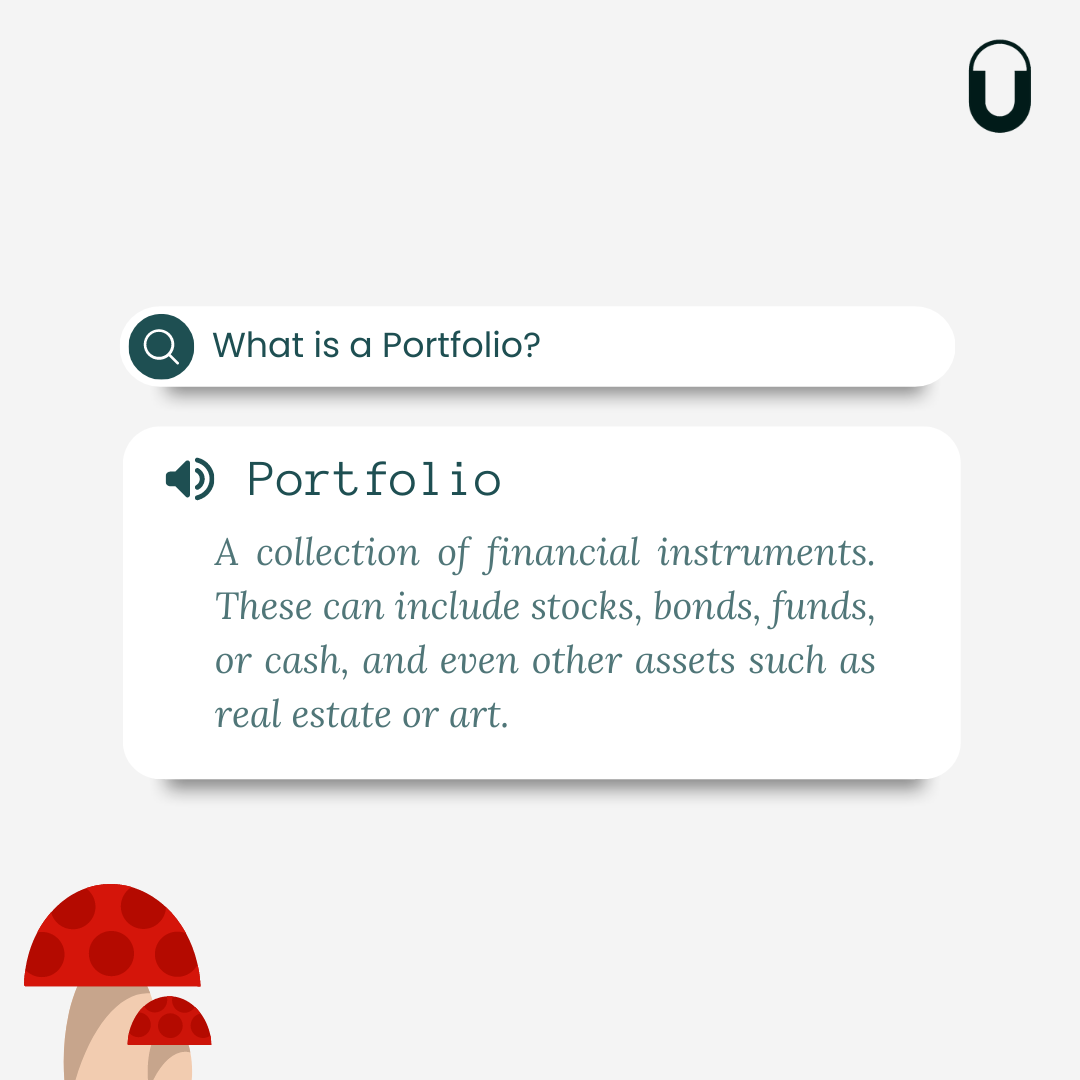
💡If we are talking about finance, a portfolio is simply a collection of various financial instruments. These can include stocks, bonds, funds, or cash, and even other assets such as real estate or art.
Now, you might be asking yourself: What are the benefits of building a portfolio? Is there something I need to consider or can I simply put together a random selection of stocks, bonds, etc. to enjoy its benefits? Let’s start with answering these questions one by one.
The Idea of Diversification
The main benefit of a portfolio lies in what is likely to be the most important term in investing: diversification. Put simply, a diversified collection of investments (i.e. a portfolio) greatly reduces the risk of the individual investments, if they are weakly or even negatively correlated to each other. Correlation? Let us take a brief step into your basic statistics class: Correlation measures the linear dependence of two variables, without saying anything about cause and effect (remember the saying: “correlation does not imply causation”). When it comes to finance, this measure indicates how two securities move in relation to each other. If they are positively correlated, we expect them to behave in a similar way - both will either go up or down. Negative correlation, on the other hand, means that if one goes up in price, the other one is likely to go down. It is intuitive to see this if we think of different industries and how they are affected by shocks. A prime example of negatively correlated industries are the oil market and trucking or aerospace companies. When the price of oil, and thereby also the stock value, goes up, trucking companies face higher costs and their revenue will fall, causing a drop in their stock value. On the other hand, two competing tech-giants will likely be similarly affected by the market and are therefore not considered a diversified set of securities. This does not only apply to stocks from different industries, but includes various financial instruments.
If you are not familiar with investment types alternative to stocks, here is a list of some of them:
Cryptocurrency
Private Equity
Art
Watches
Spirits (Whisky, Wine, etc.)
Real Estate
Metals
💡Art is commonly considered to be weakly correlated with the stock market and is therefore considered to be an attractive diversification tool for those with a high exposure in the stock market.
There are also different methods of diversifying within one asset class, such as stocks. This means that you can greatly reduce your portfolio’s concentration risk by diversifying across industries, market cap, stages of maturity, and growth rate - the first of which is likely to be the easiest for those of you not yet familiar with the other parameters. By investing in stocks from a variety of industries, you expose yourself to more than one source of risk which greatly reduces uncertainty in returns, overall.
Building a Portfolio From Scratch
Building a portfolio really sounds more complicated than it is. Basically, it simply means that you invest in various different instruments instead of putting all your hope into one type of investment from one industry, only. This strategy would imply a huge risk, as you can lose your entire investment value if that single instrument is hit by a shock. Clearly, not the best idea if you wish to grow your finances. Also, if you have a broad exposure to different industries and investment types, you also increase your chances of hitting the jackpot, on top of lowering the risk of losing everything at once.
💡As Andrew Lo, professor at the MIT Sloan School of Management, puts it: When thinking of selecting a new stock into a portfolio, ask yourself the question: “Are you contributing to my return and reducing my overall risk?”
It is advisable to start out building a portfolio with stocks from different industries or, even easier, invest in an ETF that offers a broad exposure to industries and firms, where the risk is not too highly correlated. When you are already invested in a plethora of stocks, you can look into cryptocurrencies or bonds to diversify your portfolio further. Although there remains some correlation between such instruments given the overlap in markets, you can benefit from different sectors by choosing such asset classes.
Clearly, there are some financial difficulties for many people to start investing in companies via private equity or buy a property or vintage watch. If you still want to increase your exposure to alternative investments, there are opportunities for you to invest in only parts of such assets. For example, you can invest a specific amount of money in a watch where various investors are buying into. The same counts for real estate, cars, or other alternative investments. In doing so, you do not own the entire asset, but you do own parts of it - similar to how a stock buys you a certain share of the company issuing it.
If you are still unsure about how to build your portfolio from scratch, here are some tips on how to choose your securities:
Choose asset class. What asset classes are you interested in? What share should these individual classes take in your portfolio? Remember, there are some less risky asset classes (e.g. ETFs or government securities) and those which bear a higher risk (e.g. equities or real estate). If you are only starting out and do not have a ton of money to allocate in investments, it might be a good idea to stick with less risky assets and increase your level of risk, if desired, the more comfortable you get - both financially and in your own investment skills.
Choose individual sectors in equities. When it comes to shares, you should consider the individual sectors you want to invest in. Whilst highly innovative sectors such as technology tend to be higher in risk but also higher in expected returns, the opposite is true for rather conservative sectors, such as the fast-moving consumer goods (FMCG) industry.
Choose credit risk in bonds. As compared to equities, which differ mainly due with respect to their industries, bonds are differentiated by their credit risk. Essentially, it is the risk that the issuer of a bond cannot repay the promised amount. This is mainly an issue for corporate bonds, which promise a higher expected return but bear a higher risk than e.g. government bonds or other ones that are secured by collateral.
Choose alternative commodities. Alternative commodities can include everything from watches, art, real estate, or private equity. Whilst the latter two tend to bear a higher risk due to the markets being fairly uncertain, luxury goods such as watches or art have shown an increasing trend in their value with a higher certainty. However, as mentioned above, these types of investments tend to require higher upfront costs if bought as a whole, so you might want to consider partial holdings of such commodities.
💡 Only invest as much money into highly risky asset classes as you are willing to lose and allocate the rest into safer alternatives. In doing so, you minimise the risk of losing your hard-earned money that you might need in emergencies or for your own future.
Rebalancing
As we all know: things change and so do financial markets. Now, what does this mean for your portfolio? It means that it needs to be rebalanced from time to time, or, in other words, adapted to fit the current market conditions. This is by no means rocket science and can be done via different strategies, some of which include:
Calendar Rebalancing: Probably the most simplistic approach to rebalancing your portfolio. You can set yourself a specified frequency, e.g. monthly, quarterly, etc., to change your exposure to the different assets included in your portfolio. Keep in mind: Selling and buying assets usually involves some transaction costs, so try and keep the rebalancing frequency at only a few times per year.
Percentage of Allocation: The portfolio will only be rebalanced whenever an asset class falls outside of a predefined tolerance level. For example, if you specify that you want 60% of your portfolio in shares with a +/- 10% tolerance level, your portfolio will be rebalanced whenever that percentage goes below 50 or above 70%.
Mixing the two: This strategy combines the two above in that you rebalance your portfolio at a set frequency, but only in case a certain threshold level is exceeded for a specific asset class.
💡You should tend towards rebalancing your portfolio around 2x / year, given the transaction cost that it implies.
As we were hopefully able to show you, building a portfolio is fairly easy and - as with pretty much everything in life - you will get better at it the more you do it. The aim of having a diversified portfolio is to expose yourself to as many sources of risk as possible. Although this might sound counterintuitive at first, this is how you can minimise aggregated uncertainty if these risk factors are as little correlated as possible. Clearly, diversifying your portfolio becomes easier the more money you have to allocate to different asset classes. However, you do not need a specific amount of money to invest safely! Even if you only have a little bit of savings you want to invest, you can put that money into an already diversified type of investment, such as an ETF, instead of e.g. one single equity. You will thereby already achieve a certain level of diversification. With every additional investment, you can lower your overall exposure to risk even further by increasing your exposure to different sectors, security types, and other sources of risk. Remember: It is not rocket science and with a little practice, you can become a pro at building your portfolio!
💡Go to www.umushroom.com and start building your portfolio without having to invest any real money. This will give you the necessary set of skills which you can then apply to the real financial market. Even if you do not feel ready or have savings to start investing, you can get started today and increase your chances of becoming the star investor you can be!