What is an ETF?

Have you ever looked up ‘ETF for dummies’? Look no further!
Warren Buffet once famously said, “never invest in a business you do not understand”. Or, as we would rephrase it: never invest in anything you cannot understand. Research is a powerful tool but can be confusing as we often wonder how and where to start. This is what we from UMushroom are here for. Our mission is to provide you with and guide you through the jungle of financial information. With this being said, let’s dive into the topic and start with the definition of an ETF.
What is an ETF?
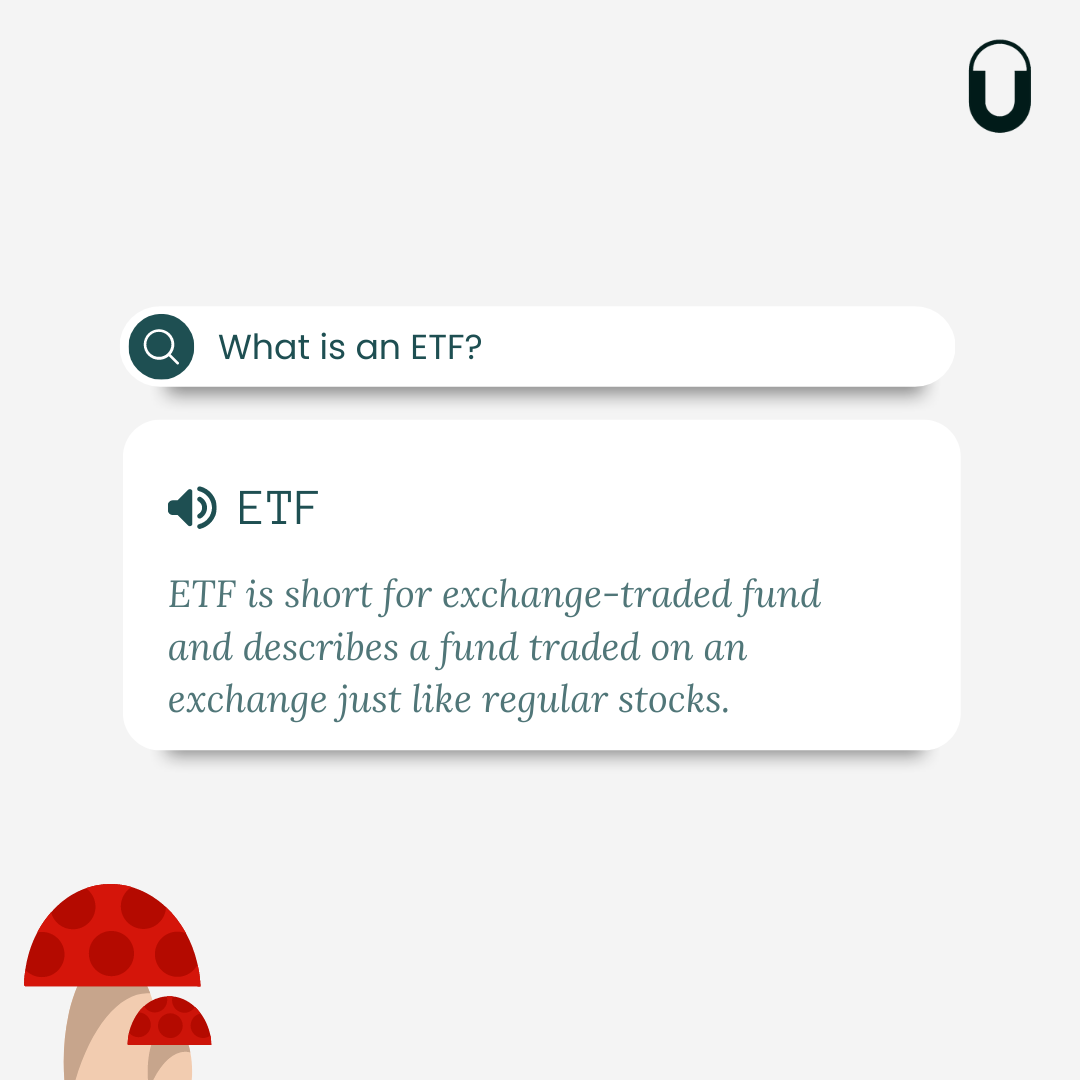
ETF is short for exchange-traded fund. As the name implies, it describes a fund traded on an exchange just like regular stocks. This means that you can buy and sell your shares more often than with mutual funds. Funds update their prices (Net Asset Value) once per day. ETFs usually track a specific investment strategy or indexes that represent a market or industry sector and can therefore offer lower fees than other funds. So as you see, ETFs have a lot in common with mutual funds but differ in various characteristics.
So… that’s it?
Well yes, but actually no. At this point, we have good news and bad news for you. The bad news first: If this was everything to know about an ETF and investing, the world surely would be a less complicated place. Unfortunately, our investment decisions wouldn’t be as smart as they should be. So here comes the good news: There is more to know! - still sounds bad? We’ll help you understand what you’re investing in so you can make informed investment decisions. What for? To avoid unpleasant surprises. We’ll keep it interesting, promise!
How does it work?
It’s best to understand the assets you invest in. So how do they work? ETFs usually map an index by either full replication, sampling, or synthetic replication. Sounds very technical, but actually, it is easy to understand. So if you want to impress your friends and family at the dinner table, just remember the following:
Full replication simply means buying every stock an index includes and weighting them as the index does.
Sampling follows similar principles. The ETF only invests in a selection of the assets an index includes.
and last but not least, there is synthetic replication. This means investing in derivatives that pay the same return as the index without picking single stocks.
Why is this important? Because the strategy is set in advance and gets executed automatically. This is why ETFs tend to be more cost-effective. Of course, not all ETFs are the same. You should choose one based on your investment goals. So let’s have a look at the different types of ETFs.
What types of ETFs are there?
Choosing what to invest in can be difficult, as the right choice depends on your financial goals. You can choose between accumulating and distributing ETFs.
Accumulating ETFs reinvest their gains.
Distributing ETFs can pay out the return and provide you with passive income.
On the other hand, you can choose what the ETF should be invested in to diversify your portfolio. This allows you to cover multiple markets simultaneously without picking single stocks. Depending on your preferences, you can invest in ETFs that cover:
Stocks
Bonds
Commodities
Currencies
Sectors
A Sector ETF can cover companies in the health or technology sector. But there are differences between investing directly into an asset and indirectly through an ETF. Bond ETFs don’t expire as opposed to the underlying bonds. Let’s have a look at another example. Imagine you wake up one day and decide to invest in oil. Would you want to store 20 barrels in your living room? Luckily you don’t have to when investing in commodity ETFs as you do not possess the underlying physical. So all that probably sounds very attractive, but do ETFs only have advantages? Unfortunately not, have a look for yourself:
What are the pros and cons of ETFs?
Pros
Possibility to invest in hundreds of stocks at the same time
Cost-efficient
Tradable during regular market hours
Cons
No ownership of underlying stocks
Not all ETFs are equally diversified
Lack of control due to the inability to pick single stocks
What ETF should I buy?
Glad to see you’re still here after reading about the disadvantages of ETFs! At this point, you probably want to know which ETF you should buy? We can’t give you a satisfying answer as there is no best practice in investing. But we’ll guide you through the criteria you should look at when searching for the right ETF.
Strategy:
Do distribution policy and strategy match your investment goals? Does the ETF consist of a diverse portfolio of assets?Fees:
Compare the fees with other ETFs and check if any further expenses or performance fees may apply.Volume:
Low trading volumes may imply insufficient liquidity. This can hamper your ability to buy and sell your shares.Performance:
Remember one of the most important rules for investing: past performance is no guarantee of future results. But it can still be used when comparing different ETFs.
These criteria can give you a good overview when searching for suitable ETFs. And although we can’t offer you the perfect investment opportunity, you probably still want to know what some of the best ETFs are. So may we present to you the ten most popular ETFs, based on the 30-Day trading volume:
1. SPY - SPDR S&P 500 ETF Trust
2. QQQ - Invesco QQQ
3. TQQQ - ProShares UltraPro QQQ
4. IWM - iShares Russell 2000 ETF
5. SQQQ - ProShares UltraPro Short QQQ
6. HYG - iShares iBoxx High Yield $ High Yield Corporate Bond ETF
7. TLT - iShares 20+ Year Treasury Bond ETF
8. LQD - iShares iBoxx $ Investment Grade Corporate Bond ETF
9. IVV - iShares Core S&P 500 ETF
10. XLF - The Financial Select Sector SPDR Fund
Fun Fact
The SPY is not only one of the oldest ETFs but also the biggest regarding assets under management.
Key Take Away
You’ve made it to the end. But what should you take away from all of this information? ETFs offer a simple and cost-efficient way to diversify your portfolio while saving weeks researching single stocks. However, you still need to engage in some research and compare different ETFs.
Your time to shine
But enough with the theory for now. Ready to apply your knowledge? You can use our platform as an ETF-finder. Go to our browse page and search for ETFs based on your desired criteria. You can add them to the comparison and check which one suits you best!
Sign up now if you don’t want to miss any future blog posts.
Sources:
https://www.blackrock.com/sg/en/etfs-simplified/etf-explained
https://www.fidelity.com/learning-center/investment-products/etf/what-are-etfs